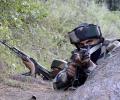
In one of the encounters in the higher reaches of Naugam, 112 kms from Srinagar, the troops cornered a group of infiltrating militants and have killed four so far.

Vinubhai Dabhi and his wife Lilaben, residents of Bhavnagar, Gujarat, recounted their harrowing experience during the Pahalgam terror attack in Kashmir. Dabhi was injured by bullets while his wife witnessed the shooting of a young man, Smit Parmar. They both highlight the lack of security presence during the incident.

Tahawwur Rana, accused in the 2008 Mumbai terror attacks, has renewed his application to the US Supreme Court seeking a stay of his extradition to India. The Supreme Court will hear the application next month. Rana, currently detained in Los Angeles, claims his extradition would violate US law and expose him to torture in India due to his health and Muslim background. The US government has denied these claims and authorized his surrender to India, citing the Extradition Treaty between the two countries. The Supreme Court's decision will determine if Rana will face justice in India or remain in the United States.

A Pakistani army Brigadier, detained on May 6 for his alleged links with the banned Hizb-ut-Tahrir extremist group, is likely to be released soon as authorities have not found "enough evidence" to charge him.

"I'm very glad you raised this, Ishaan. I didn't plant it. I promise you. This guy does this to his dad," Tharoor replied amid laughter from the audience.

Pakistani drones were intercepted by Indian air defence in Jaisalmer. Explosions were heard and flashes seen in the sky.

The move comes a few days after the Yunus-led government dropped the portrait of the country's founding father and deposed prime minister Sheikh Hasina's father Mujibur Rahman from new currency notes.
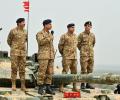
'Munir hopes to solidify his hold on power.'

'Please do not let hate win. Come to Jammu and Kashmir, come as travellers and go back as believers.'

'Will Imran compromise with the army? We are all human beings. We all compromise.'

The Border Security Force (BSF) destroyed five Pakistani posts and a terrorist launch pad across the Jammu border in an operation, an officer said. The BSF retaliated after Pakistan targeted civilian areas and Indian establishments in a systematic manner, the officer said.
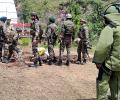
The officials said dozens of unexploded explosives were destroyed by the experts along the Line of Control in Rajouri and Poonch districts and along the International Border in Jammu and Samba which witnessed intense cross-border shelling and drone attacks from May 7 to May 10.
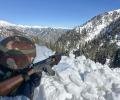
The exchange of fire occurred even though the directors general of military operations of India and Pakistan spoke over the hotline on Tuesday amid rising tensions between the two countries over the Pahalgam terror attack on April 22.

The accused, identified as Kasim (34), had travelled to Pakistan twice -- first in August 2024 and again in March 2025 -- and stayed there for about 90 days, they said.

The Indian and Pakistani militaries targeted each other's installations using missiles in the last over 12 hours, further escalating the already tense conflict situation.

This was for the second time in the past six years that Hussain, who also worked for an intelligence unit of the Pakistani army, was arrested while trying to infiltrate into this side from across the border.

Heavy Pakistani shelling in the border district of Poonch in Jammu and Kashmir left nine people dead and 28 injured. The shelling, described by residents and officials as "barbaric and cowardly", started around 2 am, damaging dozens of residential houses, shops, vehicles, and heritage sites. The incident comes after India launched "Operation Sindoor" in retaliation to the April 22 Pahalgam terror attack. India condemned the act, calling it a cowardly attack on civilians, and reaffirmed that civilian safety remains its top priority.

More than 118 Pakistani forward posts and their surveillance system were completely destroyed by the BSF during Operation Sindoor, dealing a major blow to the neighbouring country, Union Home Minister Amit Shah said on Friday.

'There's a lot of sense in what Prime Minister Modi did, but the Indian government has to be really prepared for a really sharp escalation spiral.'
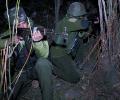
For the ninth consecutive night, Indian and Pakistani troops engaged in small arms fire along the Line of Control (LoC) in Jammu and Kashmir, continuing a pattern of heightened border tensions. The skirmishes, initiated by Pakistani troops in violation of the ceasefire agreement, have led to a tense situation along the LoC and International Border (IB). The incidents come in the wake of the April 22 terror attack in Pahalgam, which claimed the lives of 26 people, mostly tourists. Civilians residing near the border have begun preparing their bunkers, anticipating potential escalation. Despite a recent hotline conversation between the Directors General of Military Operations (DGMOs) of India and Pakistan, where India cautioned Pakistan, the ceasefire violations persist.
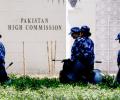
Pakistan has expressed condolences over the deaths of tourists in a terror attack in Pahalgam, Jammu and Kashmir, that killed 26 people. The Foreign Office spokesperson said Pakistan is concerned at the loss of tourists' lives and wished the injured a speedy recovery. The attack, claimed by The Resistance Front (TRF), a proxy of the banned Pakistan-based Lashkar-e-Taiba (LeT), is the deadliest in the Valley since the Pulwama strike in 2019.
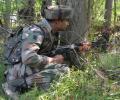
The shelling hit a village in Laam belt of Nowshera sector, killing Akhtar Bi and injuring her husband Mohmmad Hanief.

The daring action is in retaliation to the ceasefire violation by Pakistan along the LoC on Saturday.

Gen Sharma served as the Army chief from 1988-1990 and was a colonel when he took part in the 1971 war.

Congress leader Udit Raj criticized party colleague Shashi Tharoor for his reported remarks that India breached the Line of Control (LoC) for the first time during the 2016 surgical strike on a terror base, saying he should be declared a "super spokesperson of the BJP". Raj argued that India had crossed the LoC in 1965 and 1971, and that the UPA government had also conducted surgical strikes. Tharoor had reportedly said that India breaching the LoC to conduct a surgical strike was "something we had not done before". This is not the first time Raj has criticized Tharoor for his comments on India-Pakistan relations. Last month, Raj had hit out at Tharoor for his reported "no country has 100-per cent foolproof intelligence" remarks, questioning how Tharoor could be giving the BJP a "clean chit" on the Pahalgam terror attack. Tharoor had hit back at Raj, saying the latter is a former BJP MP and "is better qualified to understand who speaks for the BJP".

The lawmakers also hailed the strong strategic partnership between India and the US during a meeting with an all-party delegation led by Congress MP Shashi Tharoor, who briefed them on the cross-border terrorism faced by India and the country's strong and resolute stance in the fight against terror.

'Operation Sindoor is still ongoing. The Prime Minister himself said that blood and water cannot flow together, that talks and terrorism cannot go together. So how can we have a cricket match with a country that indulges in terrorism?'
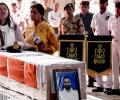
'If Pakistan's army wants to escalate violence in Kashmir, they have an unlimited supply of jihadis they can train and send. That's not an issue for them.'
Dar's statement, echoed by another federal minister, came as the Indian and Pakistani militaries targeted each other's installations using missiles in the last more than 12 hours, further escalating the already tense conflict situation.

It marked a "milestone" in India's journey towards technological self-reliance in military operations, the ministry said on Operation Sindoor.

Jyoti was among 12 people who have been arrested from Punjab, Haryana and Uttar Pradesh over the past two weeks on charges of espionage, with investigators pointing at an alleged Pakistan-linked spy network operating in north India.

'The background for the Saudi-Pakistan agreement is the fact that the regional security order has collapsed due to the Israeli attack on Doha.' 'The Americans have largely abandoned their security guarantee for West Asia and the region has no choice but to look at alternatives.'

There was a ceasefire violation by Pakistan Army on a forward post in Mankote-Balnoie sector.

'The Pakistani government's growing fear of Dr Mahrang's rising popularity is evident.' 'Her defiance is inspiring.'
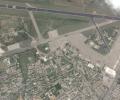
Pakistan's Prime Minister Shehbaz Sharif admitted that India's ballistic missiles hit Nur Khan Airbase and other sites on May 10, a rare acknowledgement that contradicts Pakistan's usual stance of denial when it comes to Indian military action.
At least 27 terrorists were killed and 155 passengers rescued by the security forces after Baloch militants hijacked a passenger train in a tunnel in Pakistan's restive Balochistan province on Tuesday, security officials said.
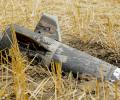
Debris resembling parts of a missile was found in a field in Hoshiarpur, Punjab, while metal parts of unidentified objects were discovered at two locations in Bathinda, sparking panic among locals. The incidents come after India successfully thwarted Pakistan's attempts to target military installations with drones and missiles across the country.

Pakistan's decision to talk to India on May 10 stemmed from realisation that it will suffer more if its operation continues, Gen Chauhan said.
An Army Junior Commissioned Officer (JCO) was killed in an encounter with terrorists along the Line of Control (LoC) in the Akhnoor sector of Jammu and Kashmir. The terrorists' infiltration attempt was thwarted, but the JCO succumbed to injuries sustained during the encounter. This incident comes after a recent brigade commander-level flag meeting between India and Pakistan to discuss border management, highlighting the ongoing security challenges in the region.
'Pakistan is economically very weak and will not be able to sustain a war for long.'
